Cross-chain lending protocol built with Arbitrum Stylus (Rust) and LayerZero. Supply collateral on Arbitrum, borrow on other chains like Base. Collateral stays on Arbitrum with isolated pools for risk
Introducing Stylend, a cross-chain lending protocol built with Arbitrum Stylus (Rust) and powered by LayerZero for omnichain interoperability.
Stylend enables users to supply collateral on Arbitrum and borrow assets on other supported chains. For example, a user can supply collateral on Arbitrum and receive borrowed liquidity on Base Sepolia through secure cross-chain messaging.
Unlike traditional lending protocols where borrowing is restricted to the same chain as collateral, Stylend separates collateral settlement and borrowing execution across networks while maintaining unified risk management. This allows capital to remain secured on Arbitrum while liquidity is accessed on another chain.
By combining Arbitrum Stylus high-performance Rust execution with LayerZero omnichain messaging, Stylend enables efficient cross-chain borrowing while anchoring collateral and core risk logic on Arbitrum.
Stylend’s core contracts are written in Rust using Arbitrum Stylus. This enables:
High-performance execution
Safer memory handling
Efficient implementation of complex cross-chain accounting
Greater flexibility compared to traditional Solidity-only deployments
Stylus allows Stylend to implement optimized collateral tracking, interest accrual, and cross-chain state verification while remaining compatible with the EVM ecosystem.
All collateral is deposited and secured on Arbitrum. Stylend centralizes:
Risk management
Liquidation logic
Health factor calculation
Collateral accounting
By anchoring these mechanisms on Arbitrum, Stylend ensures unified risk control even when borrowing occurs on other chains.
Arbitrum inherits Ethereum’s security guarantees while providing lower latency and lower transaction costs. This makes it suitable for:
Frequent health checks
Cross-chain state synchronization
Interest accrual updates
Liquidation triggers
Stylend uses Arbitrum as the coordination and settlement layer for all cross-chain positions.
Users can:
Supply collateral on Arbitrum
Initiate a borrow request targeting another chain
Receive borrowed liquidity on the destination chain
Collateral remains locked on Arbitrum, reducing fragmentation while enabling capital access across ecosystems.
Even though borrowing can occur on multiple chains, risk is managed in a single location on Arbitrum. This means:
Health factor is globally calculated
Liquidations are coordinated from one source of truth
Cross-chain positions remain unified
Stylend avoids fragmented risk models commonly found in multi-deployment lending architectures.
Supported assets, markets, chains, and cross-chain routes are curated to ensure secure messaging, reliable liquidity, and predictable execution behavior.
This design prioritizes protocol safety, structured market expansion, and operational reliability.
LayerZero enables Stylend to send verified cross-chain instructions for:
Borrow execution
Repayment synchronization
Position updates
While liquidity may exist on multiple chains, settlement and risk accounting remain anchored on Arbitrum.
Stylend functions as a cross-chain borrowing protocol with centralized risk coordination and distributed liquidity endpoints.
Operation | Solidity (EVM) | Stylus (Rust/WASM) | Gas Savings |
|---|---|---|---|
Keccak256 hashing (batch) | ~145,000 gas | ~19,400 gas | 86.6% |
Ed25519 signature verification | ~904,000 gas | ~226,000 gas | 75% |
Poseidon hash (zk-friendly) | ~86,952 gas | ~11,887 gas | 86.3% |
Poseidon vs Yul (hand-optimized) | ~19,236 gas | ~11,887 gas | 38.2% |
One of Stylus's most significant advantages is memory pricing. The EVM uses a quadratic per-call memory pricing model, making large memory usage prohibitively expensive. Stylus introduces a novel exponential pricing mechanism that dramatically reduces memory costs.
Resource | Solidity (EVM) | Stylus (Rust/WASM) | Improvement |
|---|---|---|---|
Memory allocation | Quadratic pricing | Exponential pricing | 100–500x cheaper |
RAM-intensive operations | Cost-prohibitive | Feasible on-chain | New use cases enabled |
Stylus programs run in WASM, a WebAssembly runtime that compiles to native machine code. Compared to the EVM bytecode interpreter:
Metric | Solidity (EVM) | Stylus (WASM) |
|---|---|---|
Runtime | Bytecode interpreter | Native machine code (WASM) |
Compute speed | Baseline | 10–100x faster |
Opcode cost | ≥1 gas per opcode | Most operations < 1 gas |
WASM call overhead | N/A | 128–2,048 gas (fixed) |
Liquidity in DeFi is distributed across multiple chains. Users who hold collateral on one chain often cannot directly access liquidity on another chain without bridging assets or duplicating positions. This creates inefficiencies and operational friction.
Capital is often idle on one network while borrowing demand exists on another.
Most lending protocols require collateral and borrowed assets to exist on the same chain. Even when protocols deploy on multiple chains, positions are isolated per deployment.
This forces users to:
Bridge collateral manually
Open separate positions on different chains
Manage fragmented risk across networks
There is no unified risk layer coordinating cross-chain borrowing.
When users want liquidity on another chain, they often need to redeposit collateral there. This duplicates exposure and fragments capital.
Instead of one global position, users manage multiple isolated positions with separate health factors and liquidation logic.
Cross-chain deployments usually operate independently. There is no single source of truth for:
Health factor calculation
Liquidation coordination
Interest accrual tracking
This fragmentation increases complexity and reduces capital efficiency.
Stylend allows users to deposit collateral on Arbitrum and borrow assets on other supported chains.
The core idea:
Collateral remains locked and accounted for on Arbitrum
Borrow execution happens on the destination chain
Risk management stays unified on Arbitrum
Users can access liquidity where they need it without moving their collateral.
Stylend treats cross-chain borrowing as one logical position.
Even if liquidity is accessed on different chains:
Health factor is calculated centrally
Collateral accounting remains consistent
Liquidation logic is coordinated from a single layer
This removes position fragmentation and simplifies risk management.
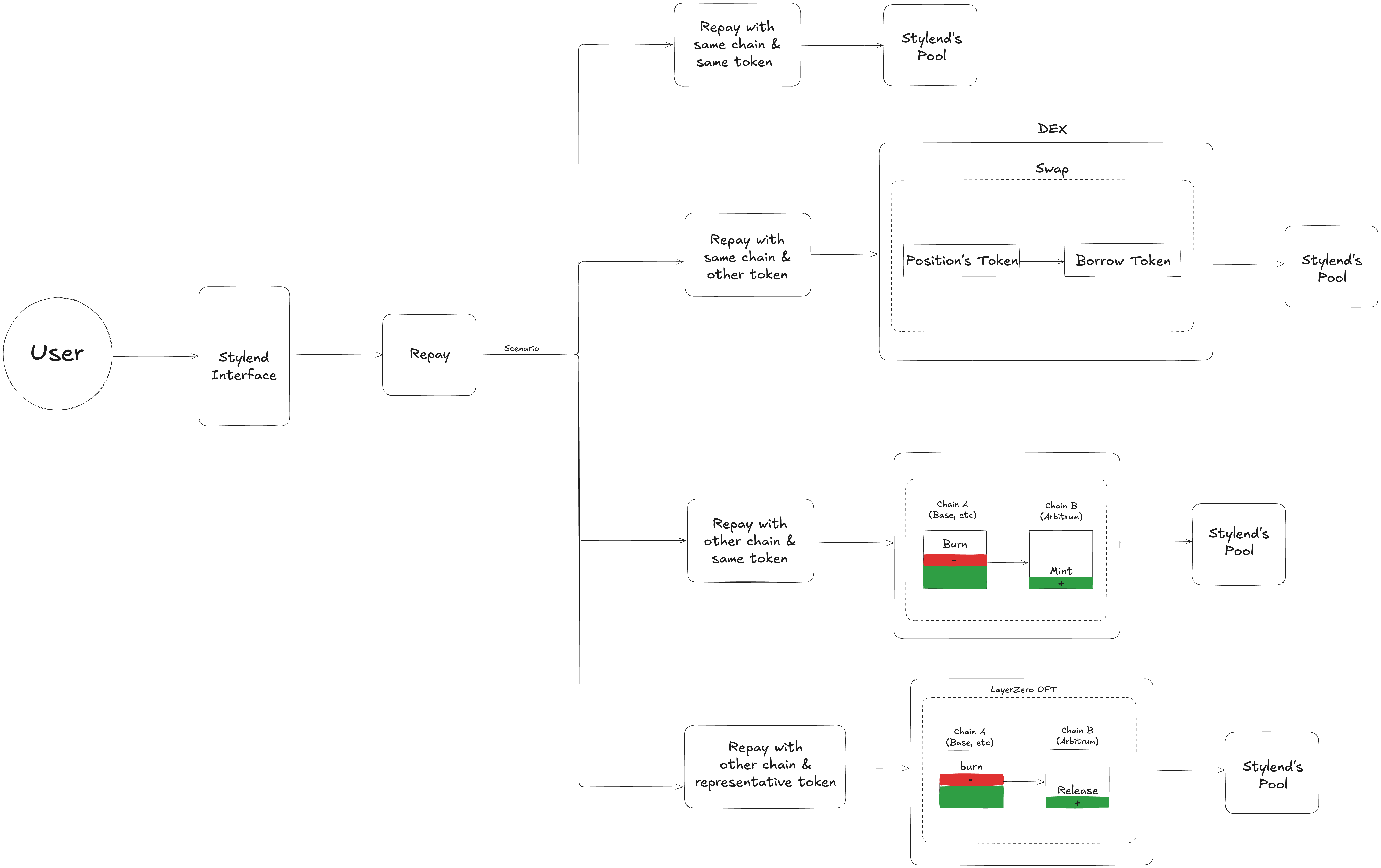
Stylend uses LayerZero to securely transmit borrowing instructions and position updates across chains.
This enables:
Borrow requests from Arbitrum to other chains
Repayment synchronization
Cross-chain state validation
Liquidity can exist on multiple chains, while accounting and settlement remain anchored on Arbitrum.
Stylend’s core contracts are written in Rust using Arbitrum Stylus.
This allows:
Efficient cross-chain accounting
Optimized interest accrual logic
Deterministic risk calculations
High-performance execution for frequent position updates
Stylend is designed as cross-chain lending infrastructure with Arbitrum as the risk coordination layer and other chains as liquidity endpoints.
Stylend enables users to supply collateral on Arbitrum and borrow assets on supported destination chains.
The borrowing flow works as a single coordinated position:
Collateral is deposited and secured on Arbitrum
A borrow request is initiated targeting another chain
Liquidity is delivered on the destination chain
Risk and health factor remain calculated on Arbitrum
This removes the need to bridge collateral or open separate positions across chains.
All risk management is anchored on Arbitrum.
Stylend centralizes:
Collateral accounting
Health factor calculation
Interest accrual
Liquidation logic
Even when liquidity is accessed on multiple chains, the position remains globally coordinated under one risk engine. This ensures consistent liquidation thresholds and unified exposure tracking.
Stylend integrates LayerZero to enable secure cross-chain messaging between Arbitrum and supported chains.
LayerZero is used for:
Borrow execution instructions
Repayment synchronization
Position state updates
This architecture allows Stylend to separate liquidity distribution from risk settlement while keeping state consistent across networks.
Stylend’s core contracts are written in Rust using Arbitrum Stylus.
This enables:
Efficient execution for cross-chain accounting
Deterministic and optimized risk calculations
Safer contract logic through Rust’s memory guarantees
Advanced position management beyond traditional Solidity-only designs
Stylus provides the performance foundation required for coordinated cross-chain lending.
Users can access liquidity on another chain without transferring their collateral out of Arbitrum.
Collateral stays secured in one place while liquidity is distributed where needed. This improves capital efficiency and reduces operational complexity compared to manual bridging and duplicated positions.
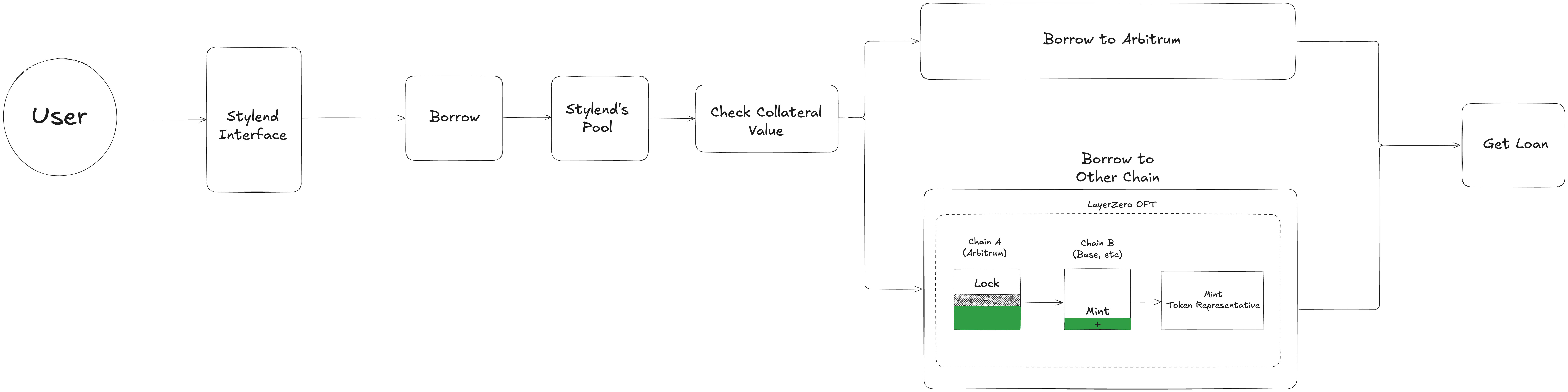
Stylend enables seamless cross-chain borrowing through a single unified position anchored on Arbitrum. Users can deposit collateral on Arbitrum and receive borrowed liquidity directly on supported destination chains without manually bridging assets or creating duplicate positions.
Powered by LayerZero, Stylend abstracts cross-chain execution while maintaining a centralized risk engine on Arbitrum. Collateral valuation, health factor calculation, interest accrual, and liquidation logic remain coordinated from one source of truth.
When a user initiates a borrow request:
Collateral is verified and locked on Arbitrum
A cross-chain message is transmitted
Liquidity is released on the destination chain
Position state is synchronized across networks
This architecture allows liquidity to be distributed across chains while risk management remains unified.
By separating liquidity endpoints from risk settlement, Stylend enables users to access capital wherever it is needed while preserving capital efficiency. Arbitrum acts as the coordination and accounting layer, and supported chains function as liquidity access layers.
Cross-chain borrowing through Stylend reduces operational friction, avoids collateral duplication, and provides a scalable foundation for multi-chain capital access built on Arbitrum Stylus.
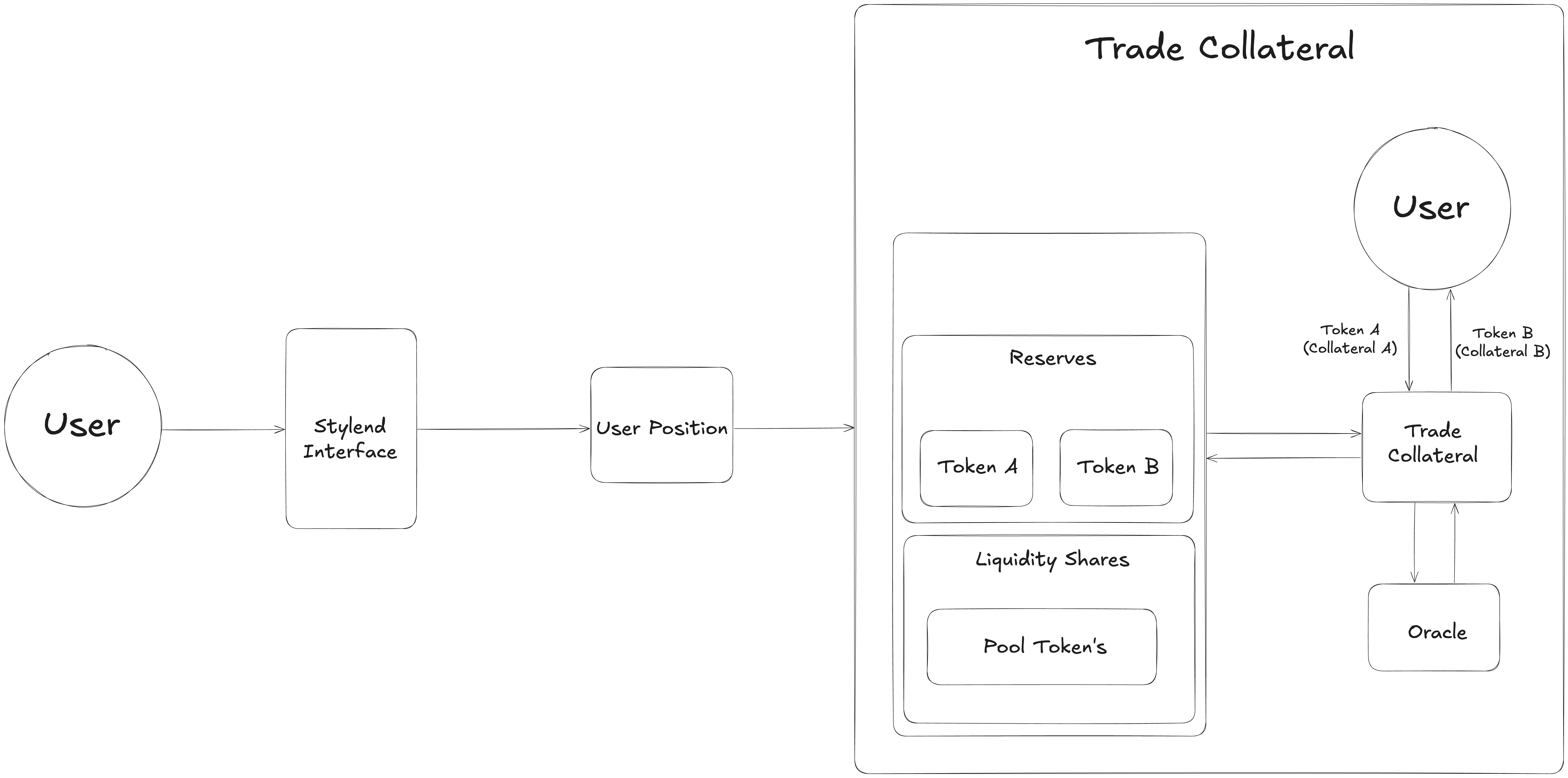
Stylend introduces a tradeable collateral mechanism that allows users to actively manage their collateral without closing existing cross-chain borrowing positions. Unlike traditional lending protocols where collateral becomes static once deposited, Stylend enables users to adjust or rotate collateral while maintaining open debt, even when liquidity has been borrowed on another chain.
This allows users to adjust exposure, respond to market conditions, and optimize capital efficiency without repaying loans or recreating positions. All collateral modifications are validated through Stylend’s unified risk engine on Arbitrum to ensure the position remains healthy and properly collateralized.
Tradeable collateral transforms borrowing into an active capital management experience, where users can rebalance risk dynamically while preserving their cross-chain liquidity access.
Stylend increases the capital efficiency of assets secured on Arbitrum by enabling users to access liquidity across multiple chains without moving collateral. This strengthens Arbitrum’s position as a capital base while extending its reach into multi-chain liquidity markets.
By anchoring collateral and risk management on Arbitrum, Stylend ensures that value secured within the ecosystem can be utilized beyond a single network.
Stylend centralizes settlement, collateral accounting, health factor calculation, and liquidation logic on Arbitrum while enabling cross-chain liquidity execution through LayerZero.
This architecture positions Arbitrum as the coordination and risk management layer for cross-chain borrowing, reinforcing its role as a high-performance DeFi execution environment.
Built with Arbitrum Stylus using Rust, Stylend demonstrates how high-performance smart contract design can support complex cross-chain financial logic.
By leveraging Stylus, Stylend showcases:
Efficient cross-chain accounting
Deterministic risk validation
Optimized position management
Advanced lending infrastructure beyond traditional Solidity patterns
This contributes to the evolution of sophisticated DeFi systems built directly on Arbitrum.
Stylend connects Arbitrum-secured collateral to liquidity endpoints on other supported chains. Users can access capital where opportunities exist, while Arbitrum remains the anchor for risk and settlement.
This model strengthens Arbitrum’s role as a foundational capital layer in an increasingly multi-chain ecosystem.
Stylend provides structured and secure cross-chain lending infrastructure built on Ethereum-grade security through Arbitrum.
With unified risk management, cross-chain messaging, and high-performance execution through Stylus, Stylend lays the groundwork for scalable cross-chain capital markets coordinated from Arbitrum.
Stylend anchors collateral management, pricing, health factor calculation, and liquidation logic directly on Arbitrum.
All borrowing positions, including those that distribute liquidity to other chains, are secured and coordinated within Arbitrum’s execution environment. This ensures unified risk validation and consistent settlement across networks.
Arbitrum acts as the single source of truth for all collateral and debt accounting.
Stylend enables collateral secured on Arbitrum to unlock liquidity on supported external chains.
Instead of fragmenting capital across deployments, Stylend extends Arbitrum’s secured value outward. Liquidity endpoints on other chains execute borrow requests, while Arbitrum remains the coordination layer for risk and accounting.
This strengthens Arbitrum’s role as a foundational capital base in a multi-chain ecosystem.
Stylend integrates LayerZero to enable secure cross-chain communication between Arbitrum and supported chains.
LayerZero is used to:
Transmit borrow instructions
Synchronize repayments
Update position states
Maintain cross-chain consistency
This architecture allows liquidity to move across ecosystems while preserving a unified protocol state anchored on Arbitrum.
Stylend exposes structured lending infrastructure that can support integrations, automation, and advanced capital strategies.
With high-performance execution through Arbitrum Stylus and centralized risk coordination, Stylend provides a foundation for building:
Cross-chain liquidity strategies
Automated risk management systems
Integrated DeFi workflows
Multi-chain capital optimization tools
Stylend contributes to expanding Arbitrum’s infrastructure beyond single-chain lending into coordinated cross-chain capital markets.
Stylend launches its public testnet on Arbitrum, introducing cross-chain borrowing powered by Arbitrum Stylus and LayerZero.
During this phase, users and builders will be able to:
Supply collateral on Arbitrum
Execute cross-chain borrow flows to supported testnet chains
Test unified health factor calculations
Validate cross-chain state synchronization
The testnet focuses on validating core borrowing mechanics and cross-chain coordination.
Stylend undergoes comprehensive security reviews with multiple independent audit firms.
This phase prioritizes:
Stylus contract security and Rust implementation review
Cross-chain messaging integrity through LayerZero
Unified risk engine validation
Liquidation and edge-case scenario testing
Ensuring safe cross-chain accounting and deterministic risk management is the primary objective before mainnet deployment.
Following successful audits and testnet validation, Stylend deploys on Arbitrum mainnet.
This marks the launch of production-ready cross-chain borrowing infrastructure where:
Collateral is anchored on Arbitrum
Liquidity can be accessed on supported chains
Risk management remains unified
Mainnet deployment establishes Stylend as a cross-chain capital coordination layer built on Arbitrum Stylus.
Stylend focuses on expanding supported chains, assets, and liquidity endpoints.
This phase includes:
Integrating additional destination chains
Expanding supported collateral and borrow assets
Improving developer tooling and documentation
Optimizing cross-chain efficiency and risk monitoring
The long-term goal is to scale Stylend into a robust cross-chain lending infrastructure coordinated from Arbitrum.

LendingPoolFactory: 0x6Ce797460987931a88D061D0Cb2729Af36E6E754
TokenDataStream: 0x1145895ef3D3Eb9F624aCB8DC65ec40bD8E4CD39
InterestRateModel: 0x1c1C290dF8fe859778FE21eEada7A30c6D91587f
isHealthy: 0x04cF7500937C675c3b7e3Fdff007523Ada184fCf
StyLendEmitter: 0xf39cE77dE228b30eFfb947fdAB1eC2Ac961212e7
MockDex: 0xe91047615F53a62A5Be5058fAc7D890F3cc169Ba
Multicall: 0xe9a1adc452cd26cae2062d997a97a3800eaaeaa3
LendingPool Implementation: 0xf27cE702c7D69666C3eb33C5AcC48fC2A241a7af
LPRouter Implementation: 0x5DB09396b7eE5c3235a64e4f17B7f0b2eCA826E2
Position Implementation: 0x58C5EdFCce84F16c57188A4081C5977223A0CE91
SharesToken Implementation: 0x1e2D4bb9b5F253e2f15151FC027c5B0A3360CCa0
USDC: 0x5602A3F9B8A935dF32871BB1c6289F24620233f7
USDT: 0x21483Bcde6E19FDb5acc1375C443eBB17147a69a
WETH (Wrapped Ethereum): 0x48b3f901D040796f9cDA37469FC5436fcA711366
WBTC (Wrapped Bitcoin): 0xaCBc1cE1908b9434222E60D6cfEd9E011a386220
USDC: 0x4e528364E6C231dB029d3aeBBa2BF409B8A4f606
USDT: 0xd7748edFE51494B4f9b185258B360A2D8d9bF113
WETH (Wrapped Ethereum): 0x30cd2cE59d09838d2785cf92e0a3d4Ee1a459D8e
WBTC (Wrapped Bitcoin): 0xc0fD90C4c7B5AaF3610A8bDF7aC5FDc9bcC23801
USDC: 0xE6812f39802aCd8d2aca6D876e660f66c455DeAd
USDT: 0x16E44F29C4ab132B7622f88066F7fbA059b4FD64
WETH (Wrapped Ethereum): 0xfaDe11Ae9d9365D7892BEDa4e23975937307c178
WBTC (Wrapped Bitcoin): 0x410F6aD6AcAbd59B9986e955e31A70BD07166D62
USDC: 0x84338e71eef83b688d385f25d3345565bE5Bdb7d
USDT: 0xFE405cE04fC81C54A693405b169818F092443Ac5
WETH (Wrapped Ethereum): 0x211Ee1C79c71CB3102619F4cc2AC9C2C2Fe88252
WBTC (Wrapped Bitcoin): 0xfc8E7181ad9Af4baf08f1582e41B1627B47A90fb
Web: https://stylend.xyz/
Github: https://github.com/StyLend
<p>100%</p>
<p>Not fundraised yet. Looking for grants, ecosystem funding, and strategic partners to support development, security audits, and multi-chain expansion.</p>

